Showing posts with label guatemala. Show all posts

Thursday, June 11, 2015

Mayan Ruins at Ixim'che

The name for Tecpan (the town I've been living in) in Kaqchikel is Ixim'che. This is because Tecpan was once under the rule of the Kaqchikel Mayans. They established their capital right outside of modern day Tecpan, and this is the site that is now commonly referred to as Ixim'che.

Ixim'che was the capital of the Kaqchikel Mayas from 1470-1524 CE. It is now an open air museum, which we visited today.

Ixim'che was founded after the Kaqchikel broke with their former allies, the K'ichee, and fled their kingdom. The land they built Ixim'che on was easy to defend as it was surrounded by deep gorges. This was useful as infighting and wars against the K'ichee continued. However, the new city was not destined to last long. When the first Spanish conquistadors arrived in 1524, the Kaqchikel allied with them initially, providing them with aid in their conquests of other Mayan kingdoms. However, a combination of smallpox and the increased demands for tributes by the Spanish led to a break in this alliance. The Kaqchikel abandoned Ixim'che, which was pillaged and burned by Spanish troops.

This is the ballcourt - where criminals, enemies, and other unpopular folks played for their lives. Two teams competed to get a heavy, hard rubber ball into a small hoop using only their elbows and hips. The losers were sacrificed.

Ana & Pedro

Yours truly!


The ruins are in a beautiful location, surrounded by the mountains, quiet and peaceful
 One of the altars for Mayan rituals. We came to it just as the ceremony had been finished. We met the 'counter of the days' who had done the ceremony - he actually turned out to be one of Ana's cousins (this was not so surprising - Ana's cousins are everywhere) Some of the offerings included bananas, Coke, and an (initially) live bird

The other side of the main alter. It was covered with yellow flowers - an unusual site according to Pedro and Ana

This butterfly was resting in the ashes of one of the altars. Apparently, they use a lot of sugar in the ritual (?) That's alse why you can see bees - which were swarming around. Don't miss the feathers from the former chicken! 
Kaqchikel word of the day: xex (SHESH) - the smell of raw egg. This was a very controversial vocabulary addition - Grace insisted that fresh, raw eggs did not have a smell. I think they do have a smell, but had never stopped to think about it. Nevertheless, this is an everyday word/smell in Kaqchikel. Do you think that raw eggs smell?

A Who's Who

The oldest daughter of my host family, Andrea, is turning 10 today. Feliz cumpleaƱos/Happy birthday/Kikotem roma aq’ij Andrea!
The birthday girl!
For the past (nearly) two weeks, I’ve been hosted by the Rodriguez family here in Tecpan. Ixchel and David have been really hospitable and kind and their three kids – Andrea, Sofia, and baby Diego – are adorable. Ixchel is a native speaker of Kaqchikel which gives me a good opportunity to practice! The rest of the family understand Kaqchikel but tend not to speak it. Which means I’ve been doing a lot of talking in Spanish – or at least attempting to. Due to not having direct contact with the language since some ill-fated classes in middle school, I would put my Spanish somewhere in between abysmal and drunk. For instance, I can only use the present tense and the difference between para and por still escapes me. But, I manage to communicate somehow! With many mishaps and frantic hand gestures, of course. My greater challenge is in class.
Iximnik'te reviewing the parts of town - with a sliver of Grace to the right. Class is held at Ixim's house
In Kaqchikel class, the primary teacher, Iximnik’te, teaches in a Spanish medium. Surprisingly, this hasn’t been as insurmountable of an obstacle as I expected – largely due to the English-speaking presence of the secondary teacher, Ana, and my fellow classmate, Grace.
Grace and I make up the student body of this year’s Kaqchikel class. She is a volunteer with Wuqu Kawoq and, in many ways, a superhero to me. She is a fluent speaker of Spanish, is studying/working in public health, and has long-standing experience living in Latin America. She has already studied K’ichee – another Mayan language. Besides all this, she’s a pleasure to talk to!
Ana is a native speaker of Kaqchikel and a great resource for my non-fluent-in-Spanish self. After having lived in the US for many years, she’s now back in Guatemala with her family and starting up various programs to help her local community.
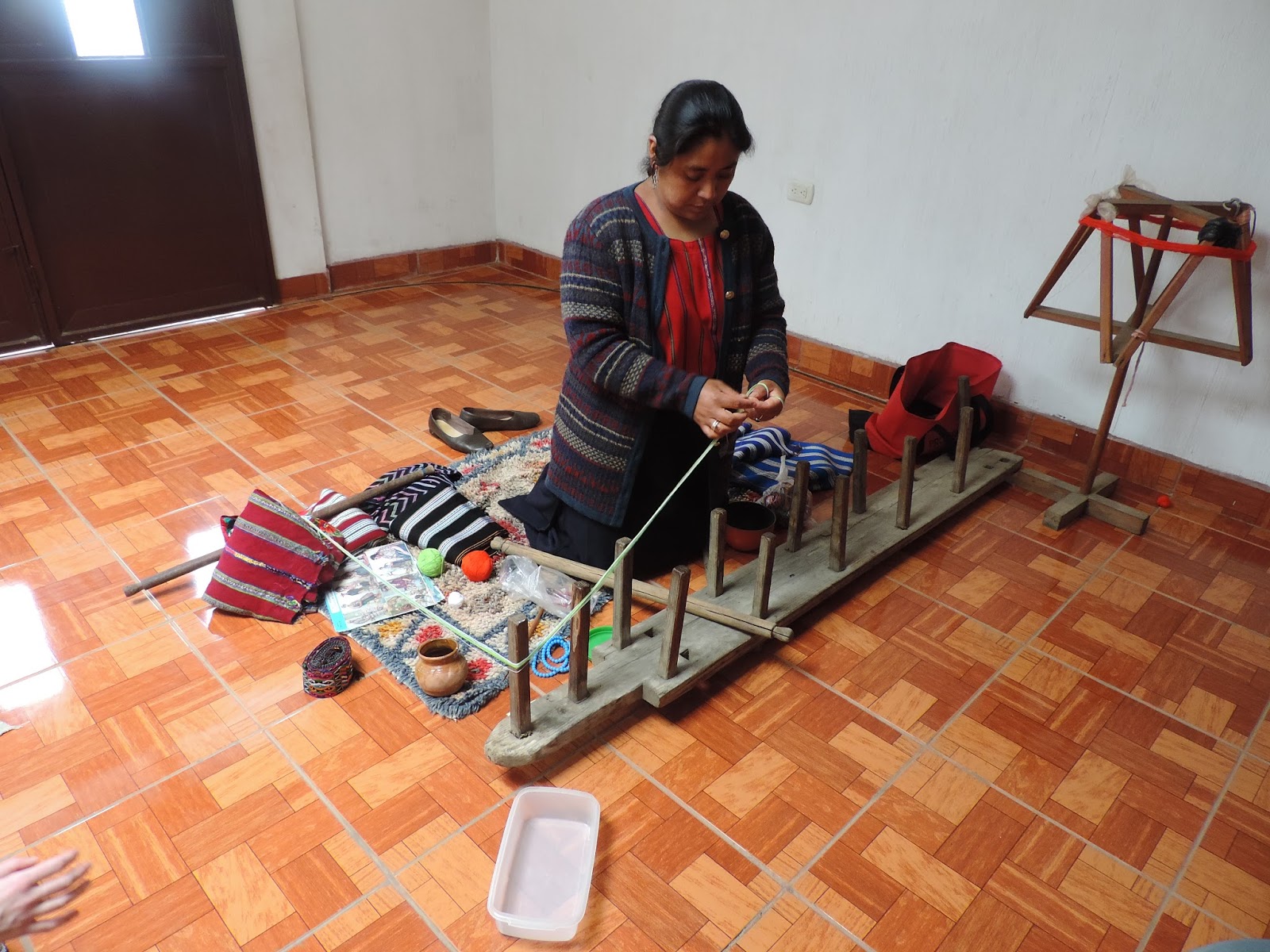
Here's Ana, Pedro, and Grace. Ana is demonstrating traditional weaving.
Ana showing us how the thread is prepared before it is woven into cloth
The fifth member of our cozy class is Pedro. (Dr.) Pedro is the bridge that connects my linguistics background at Maryland to Guatemala and Kaqchikel. A former post-grad and current colleague of Dr. Polinsky’s, Pedro is a linguistics professor here in Guatemala. He has done a lot of work in the corner of syntax that I’m probing and has been invaluably helpful. As the husband of Ana, together, they form my main support and inspiration here. I’ll be going to live with them for my final two weeks in Guatemala!

That’s the gang! I feel so lucky to be surrounded by such kind, intelligent, and inspirational people.


Kaqchikel word of the day: simil (see-MILH) – The smell of the earth after the first rain OR the smell of a delicious meal.

Sunday, June 7, 2015

A Dip into Syntax: Ergativity

One of the reasons that Kaqchikel is a particularly interesting language to study from a linguistics point of view is because it displays a relatively rare type of sentence construction known as syntactic ergativity.

Here's what that means:

Kaqchikel, like English, has both transitive and intransitive sentences:

Examples:


  • The boy hugged the girl Transitive
    • The action in the sentence ('hugged') has two arguments
    • There is both an agent - the boy - and an object the girl
    • Therefore, the sentence and the verb are transitive
  • The mare gallops = Intransitive
    • The action in the sentence ('gallops') only has one argument
    • There is only a subject - the mare
    • Therefore, the sentence and the verb are intransitive
The other thing that is happening in these sentences is agreement. One way to check agreement is by replacing the arguments (the boy, the girl, the horse) in the examples with pronouns (he, her, she.) You would get the following sentences:
  • He hugged her
  • She gallops
This shows what you probably already know. In English, there are two sets of pronouns. One set (he, she, we, they, etc) is used for subjects (Sof intransitive sentences and agents (Aof transitive sentences. The other set (him, her, us, they, etc) is used for objects (O) of transitive sentences. Therefore, when S aligns with A (which both have nominative case) against (which has accusative case,) the system of the language is accusative.

English is a nominative-accusative language.


However, in Kaqchikel, this is not the case. In Kaqchikel, there are also two types of alignments (though this is not expressed through pronouns, but markers on the verb.) But here, aligns with (which both have absolutive case) against (which has ergative case,) which makes the system of Kaqchikel ergative.

Kaqchikel is an ergative-absolutive language.

So, if we were to imagine that English was an ergative-absolutive language that displayed this through pronoun alignment, the above examples would look something like:

  • He hugged her
  • Her gallops
Here's a commonly used visual to help explain the above:

Why is ergativity useful to linguistics? Well, in accusative languages like English, the grammatical function of 'subject' of a sentence (the intransitive & the transitive A) is not separable from the case of the arguments (since the share the same case = nominative.) In an ergative language the grammatical subject (Adoes have different case marking (= absolutive; = ergative.) This allows the functions of grammar and case to be teased apart and tested separately - which cannot be done in English. 

Okay, great! But we are not quite done... The above was an explanation of morphological ergativity. Kaqchikel has morphological ergativity but it also has syntactic ergativity. So, what's that? 

I should warn you - here is where my understanding (and the general academic understanding) of this phenomenon weakens. The literature is sparser, but subsequently more provocative. 

Anyway, in order to talk about syntactic ergativity, we have to discuss extraction. 

In English, extraction can be seen in several different constructions. Two such are wh- questions and relative clauses. Some examples:
  • John gave the teacher an apple - (di)transitive
    • Wh-question: What did John give the teacher?
    • Relative clause: The apple that John gave the teacher... 
      • In both the wh- and relative clause, 'the apple' has been extracted from the first sentence and has been fronted to the beginning of the sentence. This shows that this segment of the sentence 'the apple' is one unit capable of retaining meaning even when it is moved out of its original place.
    • Similarly, we can do this for the other arguments in the sentence:
      • Who did John give the apple to? (Extracts 'the teacher' via wh-question)
      • It was John that gave the teacher the apple (Extracts 'John' via relative clause)
  • John laughs out loud - intransitive
    • Wh-questions: Who laughs out loud?
    • Relative clause: John, who laughs out loud...
So, in English, we can extract the SA, or O. However, in a syntactically ergative language, the ergative subject, or A, cannot be extracted. Kaqchikel is one such language. In Kaqchikel, direct extraction of the is avoided by using sentence constructions known as agent focus and antipassivization (which I won't go into now.) 

And there you have it! That's syntactic ergativity. And why is it of such interest to linguists? Mostly, that's because it is difficult to explain. There are a few theories for why it exists - perhaps ergative extraction is more difficult for speakers to process than absolutive, nominative, and accusative extraction? Or maybe there is some internal grammar at work that prevents the ergative extraction? This is a contested area without any prominent explanation so far, which makes it interesting to explore!

Hopefully this has been somewhat helpful in elucidating this area of linguisic theory, how it relates to Kaqhikel, and how it relates to my interest in the language. 

(Side note: So far, all known syntactically ergative languages are also morphologically ergative, but the opposite is not true. Therefore, syntactic ergativity is a subset of morphological ergativity.)

Matyox! Ke ri' k'a!

Kaqchikel word of the dayKe ri k'a (ke ree K'A) = See you later, goodbye.
- k' is an ejective velar stop, made by sharply clicking the tongue down from the back of the palate. 


Wednesday, June 3, 2015

Welcome!

Hello friends and strangers!

The following is an attempt to catalog my upcoming month as a visitor, student, and researcher in the highlands of Guatemala.

I'm here partly through my university, partly through the NGO Wuqu' Kawoq, and entirely through pure luck. After one conversation with the amazing Masha Polinsky at a department party and a few emails, the ball was off and rolling and (despite not fully believing it myself) I was on my way to Guatemala. Despite never having been south of the US border, and possessing all the Spanish that a few classes in middle school will get you! Hm, who okay-ed this again? My role here is to be a sort of guinea pig/preliminary tester for the upcoming field station that will be collaboration (to the best of my knowledge) between the University of Maryland, Universidad del Valle de Guatemala, and Wuqu' Kawoq.


My first two weeks will be spent in the city of Tecpan, in intensive Kaqchikel language classes. I'll be staying with a local host family, who are speakers of Kaqchikel. The next two weeks, I will be staying with Dr. Pedro Mateo and his wife, Ana, in Patzun. Pedro is the main 'on-site' facilitator of the field station, and linguistics professor at UVG. I'm hoping to shadow him around, check out the to-be-field station, and also do a small pilot-type study (involving field work!) on some aspects of the syntax of Kaqchikel - which is a syntactically ergative language (a quite unusual type.)

So, I hope I can capture some of my adventures and new found knowledge here! I'll try to update as frequently as possible, but time, inspiration, and internet access are always limiting factors.

Ke ri' k'a!
See you later!